Showing posts with label invest. Show all posts

Thursday, January 14, 2016

5 Quick Ways to Automate Social Media Marketing


There are experts who tell you not to automate social media. But small businesses devote a lot of time and energy to marketing – and the job is a continuous one.  It’s essential to invest time to market your business, but often hard if you have to manage orders, market, create content, advertise and sell at the same time. According to LinkedIn, 81 percent of small and medium-sized business use social media. It’s a great way to market your small business but can turn into an unwanted distraction.


When automation is done right, it allows you to put some tasks on autopilot. Here are some great tips to keep in mind as you enter the world of automation.

Queue your tweets.

Twitter can easily turn into a time suck leading to little productivity – something your small business can’t afford. Avoid getting distracted by queuing in advance. You will reach more followers on Twitter by spreading your tweets across a few hour time frame. You may wonder how to write for social media – don’t underestimate the importance of your posts. When it comes to Twitter, make sure your message is short and scannable for more engagement.

Use apps.

It’s simple to manage automation while you travel now that most social networking tools have apps for smartphones.  Apps can save you countless hours and streamline the automation process.

Interact

Log in and interact socially on all of your social networks at least daily so that all of your posts aren’t automated. Dive in daily for spontaneous updates so you remain engaged from beginning to end. It’s acceptable to take a break from social networks when you are on a vacation, just make sure you join the conversation when you return.

Automate your RSS.

Bloggers want to share their latest posts to as many social platforms as possible. Since nearly everything that ends up on the blog eventually makes its way to social media, automation comes in to play. You can automate so that new posts get transmitted directly into your social media channels. The only catch is that you want to double check the formatting of everything prior to setting this process in motion. Pay attention to the feedback from you audience – RSS content can scream automation which may turn off some of your social audience.

Recycle your blogs.

It takes a lot of time to create new and valuable content, which is why it’s so important and smart to create pillar content that can be re-shared often. Content creators often want to know how to make your content go viral. One way to do this is to create pillar posts — ones that should not ever go out of date and will likely be shared time and again.
Remember that the goal of automation isn’t to remove all of your work entirely. It is actually to help you work more efficiently. Automation can allow you to work more effectively and frees up some time for you to spend on the other tasks that accompany small business ownership.
What tips do you have for social media automating?

Thursday, December 17, 2015

6 content marketing trends to watch in 2016

app


It's that time of year again. Columnists, bloggers, prognosticators all publish their digital marketing "predictions" for the New Year.
Personally, no can do. I'm an analyst, not a clairvoyant. And I don't possess a crystal ball. But as someone who continually keeps a finger on the pulse of content marketing and content strategy, and who conducts multiple research projects on the topics (as well as updates earlier reports), I'm trained in pattern recognition. That's what analysts do, and while not infallible, research-based analysis is a better predictor of what's to come than crystal-ball gazing, tea leaves, or reading entrails.
That qualifier out of the way, here are the content trends I'll be watching in 2016:

The content stack (again)

The content stack will continue to evolve. Rather than hundreds of point solutions, marketers will soon be able to look to one-stop solutions for their content marketing needs that incorporate most (if not all) of the eight content workflow scenarios. This will simplify processes and enable tighter integration with earned and paid media.

Senior roles focused on content

Enterprises will begin to hire more senior executives to oversee content initiatives. If 2015 was the year of the content manager or director, 2016 will usher in VP and higher roles. Content is not a channel; it's related to every aspect of advertising, marketing, and communications initiatives. As such, it requires senior, strategic oversight -- something companies are coming to recognize.
strategy


A continued need for strategy 

Content strategy will accelerate, but not enough. My research findings correlate with other studies. Overall, we're finding that some 75 percent of enterprises regularly commit to content marketing while paying no heed whatsoever to developing and documenting a governing content strategy. Objectives, goals, systems of measurement, processes, and people -- all are secondary to the burning "we need more content, and we need it now" issue. I've been speaking with my peers who, like me, help enterprises develop content strategies. More and more often, they complain that prospective clients try to engage them to keep the blog bursting with content, but not to solve the "why" or "how" of that (and similar) initiatives. Mark my words, content marketers: without the strategy in place, you'll soon be spinning your wheels, not to mention creating excess costs in money, resources, and efficiencies.

Content measurement becomes more robust and meaningful

For too long, sales has been the alpha and omega of content measurement. Don't get me wrong, sales is the lifeblood of any organization. But it's not the only measure of success, not in content nor in any other marketing initiative. I've been researching how forward-thinking companies are measuring other crucial aspects of content initiatives. These aren't meaningless volume metrics such as "likes" and "follows," but ROI-related analysis you can take to the bank (or to the CFO). Companies wise enough to build content strategies have a huge advantage here -- they'll know what they can measure, as well as how to measure it.

Global content becomes a thing

My clients are working to figure out how to manage content on a global level. What should teams look like? What tools work for international cooperation? How much central authority should exist versus local and/or regional input? What channels, audiences, creative, and messaging can be the same, and what needs differentiation on different continents, or in different countries? As content rises in importance (and display advertising correspondingly diminishes), global content strategy will be a growing concern.

Content around new things

This is 2016's most emerging and nascent trend, but one that will be huge in subsequent years. As we move from mobile content into the Internet of Things, and into a world full of beacons and sensors, content will decouple from screens in many cases, yet be associated with a growing universe of objects and things. Content will permeate the customer experience -- the "who," "what," "when," and "where" of all interactions. Your car, printer, TV, refrigerator, fitness tracker, phone -- all these devices and more will interface, talk to each other, and share content. I'm fascinated by what kinds of content will develop in the next wave of technology, and will be keeping a close eye on the horizon of content disruption next year, and in the years to follow.


Source : http://bit.ly/1Rrspev

Sunday, September 13, 2015

Who Invests In Hardware Startups?


While many angels and VCs are still skittish abouthardware startups, there has been a massive renaissance in the hardware-funding ecosystem over the last few years. Since 2010, venture capital investment in hardware startups is up more than 30x.
Hardware Startup Investment by Year
Hardware/connected device companies who have publicly raised $1M or more from institutional VCs or angels.
With this explosion in hardware funding, one of the questions we get all the time is, “Who else is investing in hardware?” We generally think about private hardware investors in three buckets:
  • Hardware-only VCs. There are a few small funds (like ourselves) that work only withhardware companies. We’re usually first money in and can follow-on but not lead futureinvestment rounds.
  • Hardware-friendly micro VCs. There are also a number of other micro VCs who invest at the seed stage but aren’t focused on hardware exclusively. They generally manage less than $100 million, invest $50,000–500,000 and fill out seed rounds, but often don’t lead.
  • Hardware-friendly traditional VCs. Generally, most capital in hardwareinvestment consists of traditional VCs, with a few being particularly active. This is especially true for consumer hardware companies.

Where Is All This Activity?

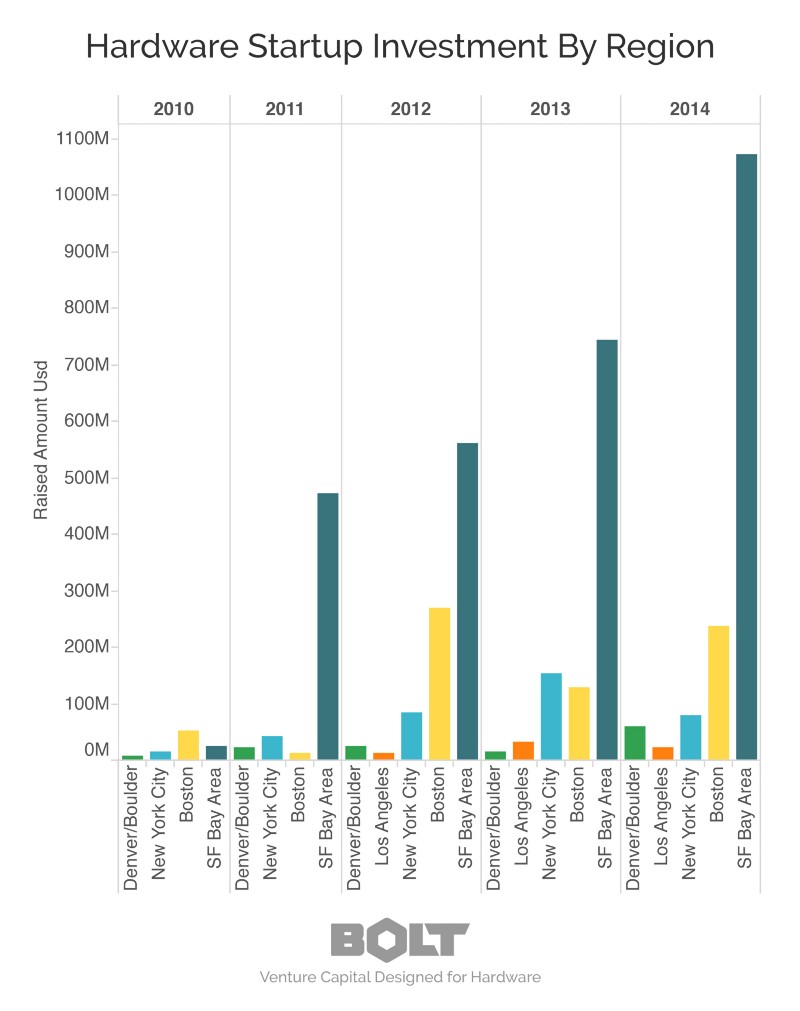
The number of funded, connected hardware startups in the Bay Area (who have publicly raised $1 million or more) currently sits around 110 by my count. Boston and NYC (which are about equal) are one-third of that. Los Angeles and Boulder/Denver are one-third again of Boston and NYC. By aggregate dollars raised, however, San Francisco completely dominates; it was almost 5x Boston in 2014 and more than 10x NYC and Boulder. Everywhere else (including internationally) is a rounding error with a few very notable exceptions (Xiaomi, DJI and Magic Leap, in particular).
Hardware startup investment by region

Why Now?

Three main dynamics have been driving private investors to seek hardware companies.
Strong Exits
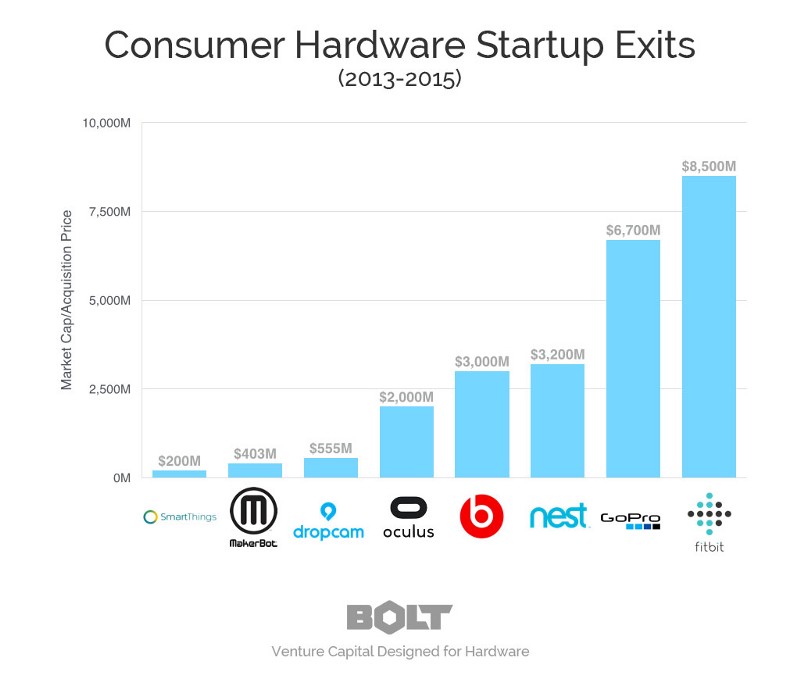
Consumer Hardware Startups

A few breakout companies have paved the way in proving that hardware companies can be tremendously profitable. Distribution and manufacturing are still hard, but GoPro and Fitbit have shown that hardware can have stronger growth metrics and outcomes than their software-only counterparts.
SaaS-Like Metrics
While traditional hardware companies have few feedback loops besides revenue and returns, connected hardware startups get constant feedback on product usage, retention and churn. This speeds up iteration cycles and helps investors (who are already comfortable with SaaS) understand younger hardware companies without as much sales traction.
Hardware + Software = Less Commoditization
Most hardware products struggle with commoditization and low margins over time. Today’s connected hardware products are often a Trojan horse for software. Software that is harder to replicate can increase switching costs and provide more opportunities to interact with customers and build brand. The upshot is a higher customer lifetime value, either explicitly through recurring revenue (Dropcam) or consumables (Kindle).
While the past few years have been banner years for venture capital investment, the connected hardware ecosystem has seen particularly explosive growth in both the number of startups and the receptiveness of VCs to funding them. This is driven by decreased development costs, shorter times to market and a shift in hardware business models away from commoditized consumer electronics to recurring revenue and software services. 
This year is on track to surpass 2014 in both number of funding rounds and aggregateinvestment, although growth is leveling off as a number of hardware categories become saturated and the ecosystem figures out who the winners are. As the hardware community evolves, there are a number of sectors where we’d love to see more hardware startupsworking.