Showing posts with label hardware. Show all posts

Saturday, January 16, 2016

10 Reasons Why Brands Should Be on Snapchat


There is no denying Snapchat’s growth. Since November, the messaging app has gained another billion views bringing it to seven billion views, Business Insider reports. The number of views has been growing exponentially for the brand, which has tripled its views nearly six months earlier. It is still just shy of Facebook’s 8 billion video views a day, but with Snapchat’s growth points that they will be passing Facebook very soon. As 2016 gets underway, it is clear that Snapchat is one of the social apps that marketers should have their brands on.
So what should you know about Snapchat before diving in?
1. Everything is short-lived; Snaps and stories only last one day on the app. Snaps are individual pictures or 10 second videos; while Stories are the compilation of the day’s stories. The ephemeral nature of Snapchat means users are continually checking in on their favorite channels and users. Users create about 800 million snaps and videos per day.
2. More than 60% of smartphone users, between 13-34 years old, use Snapchat. 37% of Snapchatters are between the ages of 18-24 years old.
3. There are at least 200 million people using Snapchat; about 100 million users are snapping daily. They are highly engaged and they are staying with the product. Snapchat thrives on engaging their users through user created content that never stays the same.
4. Snapchat Discover allows brands to get in on creating their own content. Like Stories, Discover allows brands access to 24 hour storytelling for their company. Snapchat’s layout of vertical videos and full screen layout are conducive to easy viewership. Brands like Food Network, Refinery 29, IGN and Wall Street Journal are just a few brands that are taking advantage of Snapchat Discovery.
5. Snapchat Live is a unique feature that curates user created content. Users who are at the same event location have an opportunity for their snaps to become part of the Snapchat Live story. In Brixton, London fans spontaneously gathered to celebrate David Bowie, and the snaps and videos were curated as a tribute which runs through the end of January 12th.
6. Snapchat counts video views that are less than a second; however, the user has to proactively play the video for the tally to count. Other social media giant, Facebook considers three seconds to be a view, but their videos will automatically begin to play as the user scrolls past. According to Business Insider, 90% of all brand advertisers are repeat advertisers. While it is still difficult to really monetize the ROI with Snapchat, the audience keeps bringing advertisers back. Why? It is the “in” place to be. As we said before, Snapchat tripled its video views per day in six months, and added another million views per day over the holiday period.
7. Lenses and filters are two ways that marketers can reach users on user created content. Lens is a type of feature that allows users to change their appearance. Brands can sponsor the 24-hour lens, like Beats did on Black Friday. A lens will cost a brand about $500,000-750,000. Filters (geofilters) are tied to a location or event and allow users to put a sticker, frame or drawing that overlays their snap. McDonald’s created one of the first sponsored filters which allowed users to add a burger and fries to their snap whenever they were near a McDonald’s location.
8. Snapchat is growing quickly outside the US. In the UK, Snapchat users account for 25% of smartphone users and in Norway 50% of smartphone users. The app itself is also expanding offices to the UK and taking along some powerful social media presences with them. The former director of agency partnership at Facebook in the UK, Claire Valoti, and former members of Twitter, AOL and Buzzfeed have, joined the Snapchat UK offices.
9. Snapchat is building an application programming interface (API), according to Digiday. This will allow advertisers more precision and better execution with their marketing campaigns. While the API maybe a few months off still, Snapchat has made advertising growth their focus for 2016. “Snapchat’s ambition going into 2016 is to have many more opportunities for e-commerce on the platform and other stuff that is more about building audiences,” said an ad agency executive with direct knowledge of the plans.
10. The numbers do not lie. Snapchat has set themselves up to be one of the strongest contenders in 2016. Their quick growth and their highly engaged users make Snapchat a great place for marketers to stretch their creative muscles, and tap into that hard to reach 13 to 34 year old market. With their promises of stronger e-commerce opportunities for the upcoming year, Snapchat is where marketers want to be. 

Source :http://bit.ly/1OxpDio

Wednesday, January 13, 2016

5 Biggest Ways Social Media Will Change in 2016


Here's how to stay one step ahead of the social curve.

Death and taxes used to be the only two things we could all rely on. Now we can add a third: that social media will roll out all sorts of weird changes. Entrepreneurs will then scratch their heads, wonder what this is all about, and finally jump on the bandwagon and try to catch up.
So before you scratch your heads, here's a heads-up. Five major changes are currently rumbling away in social media, and they're going to break out in 2016. You need to be ready for them.

1. Live Streaming Goes Mainstream

Live streaming is already out, but it's going to get bigger. Within months of its launch, Twitter's Periscope service already had 15 million registered users who could employ their smartphones to share instant content. Big companies have been quick to spot the opportunity. In July 2015, GE's Droneweek exercise took viewers into the company's factories and showed audiences, including the engineering graduates the company needs to attract, how jet engines, wind turbines, and locomotives are made and tested. The company got to tell its story through a week of live, authentic content.
Other kinds of content that companies can broadcast live include conferences, interviews, customer support, product demonstrations, and special offers. For small businesses, the select audiences who tune in are the most loyal customers. They're the people you want to hug closest, and live streaming brings them about as close as they can get. If you're not broadcasting live yet, expect to push up a Periscope in 2016.

2. On-Platform Content Opens Up

In 2015, Facebook snatched distribution from established content creators. Instead of publishers bringing Facebook users to their own websites, Facebook's Instant Articles program let publishers distribute their content on the social media platform. The content would load up to 10 times faster, more people would see it, and the publisher could earn advertising revenue. But the users would stay on Facebook, reducing the publisher's own brand value.
Despite the risks, 350 publications have now signed up, including The New York Times, BuzzFeed, and Huffington Post. More than 100 publications distribute their content through Instant Articles every day.
The program started on iPhones and expanded to Android devices at the end of 2015. It's still limited to select publishers, but expect registration to roll out more broadly--and force all of us to compare the benefits of showing our content on Facebook with the advantages of bringing users to our webpages.

3. Smarter Use of Snapchat

Of all the head-scratching moves in social media, few have created a greater risk of a bald spot than the rise of Snapchat. You spend time and money creating unique content for a targeted audience only to see that content disappear as soon as it's used. It's the exact opposite of the quick burst and slow burn that a good YouTube video or blog post can achieve.
And yet, companies as big as McDonald's, Acura, and Heineken have all waded in, keen to connect with the platform's young audience--and scared to be left behind.
The quality of the content has improved over the past couple of years, and it's going to get better. There are enough good case studies available now for anyone to be able churn out effective Snapchat content quickly and easily. Now that businesses no longer need to scratch their heads for good ideas, expect companies with youthful customers to start churning out disposable content.

4. Video Will Continue to Beat Static Content

At the start of 2015, the news was that Facebook users were posting 75 percent more videos than they were the previous year. In the U.S., it was closer to 100 percent, and Facebook was pushing 360 percent more video content into people's news feeds. Between April and November 2015, Facebook doubled average daily video views from four billion to eight billion. Even though the company counts a three-second glimpse as a "view," that's still a huge amount of video watching, and it shows how keen Mark Zuckerberg is to eat YouTube's lunch.
Those figures are only going to grow. Facebook has already made clear that it prefers video content to link posts and even images, so to build any kind of successful social media campaign, you will need to pull out a video camera and get shooting this year.

5. Virtual Reality Content Will Make Its First Appearance

When Facebook bought Oculus Rift for $2 billion in 2014, even the most savvy social media watchers were left bemused. But the idea is starting to become clear. Just as video is a more engaging form of content than still imagery, so virtual reality will be the next and most engaging step forward for content. The New York Times has already started creating virtual reality content that works with Google's Cardboard virtual reality viewer, and Paul McCartney invited a VR firm to film one of his concerts. It's still early days for virtual reality, but as we approach the end of the year, expect to see more moves toward a new kind of engaging content--and start scratching your head for a way to use it yourself.

Friday, January 8, 2016

16 Marketing Goals for Your Business in 2016


Every business needs to have goals. They could be financial, strategic or marketing in nature, but you still need to have them.
I have goals for my business. I’m heading into year 5 of ME Marketing Services and 4.5 years in I have reached a major goal/milestone, financially speaking. Looking towards this next year I need to have more marketing-focused goals to keep up that milestone, which lead to this post. It never hurts to take a look at the goals any business or business owner should have when it comes to the promotion and marketing of a business.
With 2016 rolling in, let’s take a look at 16 marketing goals for your business…
  1. Focus on quality content. This year, focus on the quality, not the quantity of your content. Yes, you’ll need to produce a lot of it to make waves, but put some effort into sharing things that will be meaningful to your community. According to a study by the content marketing company Fractl, “64% of writers wish they saw more infographics, mixed-media, data visualizations, images, videos and interactive maps”. Share the steak, not the mashed potatoes.
  1. Have a content marketing plan. This probably should be first, but this list is in no particular order. Content is a crucial piece of marketing. Roughly 80% of businesses will use content marketing in 2016 and beyond. This is what you publish on your website, share on Facebook, pictures you post to Instagram. You can’t go blindly into content marketing. Have a plan. If you don’t have one, start here.
  1. Find new ways to distribute content. If you’re blogging – great! If not, this is the year to start! This year, find new avenues to get your content out. This could be signing up for Triberr or guest posting on other blogs. You could also tap into your alpha audience and have them ignite your content. BuzzSumo and Fractl analyzed the 1 million most-shared articles within a 6 month time frame in 2015 and found that the top million articles showed that the most engaged platforms, in order, were – Facebook, Twitter, Google+, Pinterest, and LinkedIn.
  1. Make something other than Facebook a priority in your social media efforts. Don’t get me wrong, Facebook is a huge player, but there’s more out there for businesses than the big blue brother. If you haven’t tried Instagram, try it. Maybe venture into Twitter. Branch out this year.
  1. Go offline and do something in-person. You could spend your entire marketing budget and time on just social media and digital marketing, but that won’t reach everyone. Not everyone in your target audience is online, so go to some networking events or attend a conference. Go talk about your business!
  1. Find strategic partners. This could be online or offline. Find others with similar mindsets and businesses that compliment yours. If you’re only handling social media for clients, align yourself with someone who does web design or SEO. I’m sure you have some common clients or potential clients you can refer each other to. Likewise, if you are a brick and mortar store, selling flowers for example, partner with a local furniture store to display some of your arrangements. This is free marketing people, take advantage!
  1. Have realistic goals. Wouldn’t we all love to rake in six figures because of our marketing efforts alone? For some businesses, you may be able to. For some, that’s not realistic. Whatever you do, set a realistic goal. Sure I’d love to make $1 million this year, but realistically that isn’t going to happen. Setting up unrealistic goals will only leave you feeling depressed at the end of the year.
  1. Give away something for free (if you can). Like a moth to a flame, nothing brings in potential customers like free stuff. This could be a 30-day trial or something with purchase, offering something as a bonus or benefit will extend your business. Keep in mind your bottom line though, you don’t want to give away the farm.
  1. Outsource what you can’t handle or are not good at. Look, us marketing people (and business owners too) hate to admit we can’t do it all. We feel we should be able to do it all. Well, we could if there were more than 24 hours in a day and a had a maid at home, personal chef at home, live-in nanny, chauffeur, etc. It’s a hard pill to swallow, but outsource what you are not good at. This could be social media marketing, advertising campaigns, graphic design, etc. You’ll appreciate the time you’ll get back and the knowing someone who is capable is handling it for you.
  1. Be proactive and ready. There’s nothing like having Thanksgiving Week slip up on you and you have nothing planned for Black Friday or Cyber Monday. Know what’s coming up for your business and be prepared. Likewise, if you see something brewing (an upset client or something that could be really bad or really good for your business) know what you are doing to do when it happens – have a press release or a campaign ready to celebrate or combat it.
  1. Be prepared for the unexpected. You can always be proactive but there are times things will come out of the blue and throw you off-course, in both good ways and bad. Unfortunately you can’t plan for everything (a notion that drives me crazy, personally) so know the unexpected sometimes happens no matter how much of #9 you do.
  1. Try something new for your business. If you’ve never really spent much time making videos, start! Wanted to advertise in something local – go for it! Go outside your comfort zone and try something new. Maybe it’s time to update your branding (stay tuned this June for ours!) or your website.
  1. Find a business mentor. Having a mentor is something that is very underrated. All business owners and marketing professionals need to have someone they can look to. This could be for advice or guidance or for help in an area they are struggling with.
  1. Be a mentor. If you have the knowledge and know-how, mentor a new business owner or marketing professional. I do this through the internships my business offers. It allows college students to get real-world experience before they actually enter the real world.
  1. Make it a point to track everything. To see the full-scale results of your marketing efforts, you need to track the analytics (Facebook Insights, Google Analytics, etc.). Make sure you know what’s working and what’s not. Analytics is the first place to start.
  1. Have fun. Marketing is fun. From campaign creation to seeing the fruits of your labor, no matter how small, marketing is the fun arm of your business. Enjoy it!
Whew. 16 is a lot, but all of them are attainable by any business, regardless of the size.
Source : http://bit.ly/1kSkqZY
 

Friday, December 18, 2015

What Can I Learn By Using Marketing Automation Software?


app


Ideally, marketing automation software allows companies to track, analyze, and nurture prospects with highly personalized, useful content that helps convert prospects to customers and turn customers into brand advocates. Marketing automation software introduces precision and process to both lead generation and lead nurturing campaigns through its ability to track, score, and assign leads efficiently.
To further illustrate these concepts, I’ve taken the liberty of breaking down the knowledge that can be gained from marketing automation software into three major areas of emphasis.

1. Lead Quality

Most prospects visiting your company’s website and consuming your content have not yet entered a purchase-ready mentality. As such, sending and assigning leads near the top of the sales funnel to the sales team annoys prospects and wastes sales representatives’ valuable time. Instead, marketers should offer educational content to advance the prospect down the sales funnel before assigning them to a sales rep. Marketing automation software makes this process easy by utilizing lead scoring.
Lead scoring is a practice of attributing point values to certain attributes or actions taken by leads to measure their fit for your products/services and readiness to make a purchase. Examples include:
  • The company they work for
  • The industry they work in
  • Demographic information
  • Volume of website visits
  • Specific forms submitted (downloads and/or requests)
  • Specific pages visited
When leads reach a certain score, they are automatically shared with a sales rep, and the rep can immediately see the contact’s history of interactions with your brand. In essence, the higher the score, the higher the priority for a sales touchpoint. This allows sales reps to use their time wisely, concentrating their efforts on highly qualified sales leads rather than wasting time on low-quality leads unlikely to convert. Oh, and it’s worth mentioning again this entire process is completely automated.
2. Buyer Journey
Another area of emphasis is the buyer journey. Marketing automation software also gives marketers the ability to understand a buyer’s journey from the very first encounter with the brand to the purchase (and beyond). This knowledge is critical to decreasing the sales cycle by presenting prospects with relevant content that will hasten the path to the purchase.
For example, ABC Company notices, through marketing automation, that 90% of their customers visit the company website at least three times, visit the pricing page, and request a consultation before making a purchase. Wouldn’t it be wise, then, for ABC Company to make it a goal to have every lead go through this journey? I know I would if I were them. Specifically, I would use lead nurturing emails to make sure they make it back to my website at least three times, obviously using the pricing page and consultation landing page as my featured email links. I may even redesign my website with this information in mind; if not my entire website, at least the homepage.
Tip: I would also encourage ABC Company to assign a significant point value to each of the proven high-conversion actions—i.e. three web visits, a visit to the pricing page, and a consultation request—when setting up their lead scoring.
The goal here is to use marketing automation software and tactics to discover trends that will shorten the sales cycle and convert more customers by using information relevant to the purchasing process identified through analytics. Say that five times fast…

3. ROI

Return. On. Investment. Every marketer and business executive seeks a clearer understanding of ROI, and it is not difficult to understand why. In its simplest form, the ROI metric is asking the question “Is it working?” With marketing automation software, that question is easy to answer. You can analyze a particular campaign as a whole and/or by each sub-element (ebook, blog post, social post, ad, etc.) to understand how many leads generated or nurtured by the campaign became customers. You can also determine whether the aggregate customer purchases stemming from the campaign outweighed the price of the campaign’s execution. Easy as pie.
There you have it! I hope this gives you a clearer understanding of the various things you can learn by using marketing automation software.
quote

Tuesday, November 10, 2015

Socializing Your Brand is Not an Option but a Must.


media


With the increasing popularity of Facebook and Twitter, almost every single company that has a website is on social media. For some people, social media marketing is just a fad that can provide advantage while it lasts. And then there are others who think it’s a lot of hype around something that holds no advantage. However, socializing your brand has become more important than ever before. 
Is Social Really Important?
Almost a decade ago, marketers were pondering over the same question, thinking that it’s just a fad and will fade away in a few months or a couple of years. It didn’t. Social media is here to stay and has become even more powerful as more and more people network on it.
If you’re looking for one good reason to get social media services for your website, we have a reference list for you.
1. Two-way Immediate Communication
If your customers are upset over something, they don’t want to wait for 30 minutes while their call is put on hold. And they don’t want a 24 hour waiting period for your email. They want a quick response. Your social media service should be active on the network and reply to complaints as soon as possible. This lets other people see how helpful you are, and thus it increases your sales.
2. Transparent Communication
When a customer brings up a complaint regarding your products or services, others can read that. And when your team replies to their concerns, your fans can see how you replied to the comment. This builds a positive brand image. When communication is transparent, it helps both sides. While you build a positive image, customers get their complaints resolved quickly – so it’s a win-win situation.
3. More Conversions
You can’t make new customers with each new post, but when you solve a customer’s complaint, other people will start liking your brand. Also, your posts and replies will reflect your brand essence. Make sure that no matter what the customers say, you have to reply with a positive tone. This will build a positive aura around your brand that will encourage conversions.
4. More Followers 
When a fan experiences positive communication with your brand, they will share this experience with their friends on social media. This is the main reason this platform is called social – people discuss their good and bad experiences. If a person had a bad experience with your company, they will discuss it with their friends, and this will not be good for your brand image. When you get social media marketing services from a good company, you can turn all customer communications into positive experiences and gain more followers.
Remember, being on social media isn’t just about posting content, but also about resolving customer issues. As you answer their questions and resolve their issues, your business will be a bit more vulnerable, but if you have the right social media services, this risk is certainly worth taking.

Tuesday, November 3, 2015

The Latest Rules of Social Media Marketing

Social media is no doubt an ideal way for you to acquire new fans/followers and engage with them. It’s also an ideal tool to boost the reputation of your company/brand. In a way, social media has become an integral asset in marketing your business.


socialmedia


But how are you going to maximize its tools for your company?

Listed below are some new do’s that you should follow when it comes to your social media marketing so you’d be able to achieve your goals in no time.

Social Plan

Do you have one?
Most of us don’t.
Social plan is essential to make your social media marketing more powerful.
It’s a plan that compiles all fresh contents on your social media. You can create a daily, weekly or a monthly theme.
With a plan, you’ll have consistency. This will also allow you to send out your social updates at the right time.
When your audience knows when you’re going to post your content, they’ll go back to your site and wait for your next awesome piece of content.
Then again, what you post should provide them value. Else, they’re going to leave or unfollow you.
Even though you have a social plan, you should still monitor your channels.
Don’t just post and leave. You want your social media accounts to be as professional as possible as they reflect what your brand is.
That said, you’d want to monitor your channels and take out those spammy comments or inappropriate remarks.
Monitoring your channels will also help you find some comments and questions posted by your prospective clients.
When you’re there monitoring, you can make an instant reply and begin a real-time conversation with them.

Content Should Reflect Your Brand

change
It simply means that your content must provide value to your audience by sharing content that’s information and educational.

This gives them a sample of what they can expect when they visit your site. It also gives them a preview of what type of information is housed on your own site.

You already have followers. So, give them a reason to click through your link and visit your site.
But never assume what your audience wants. Just because you share your content on your social media accounts doesn’t mean that you’ll increase your CTR.
For that reason, you should know the profiles of those who interact with your content. In this way, you can share content that attracts attention to your potential customers.

Test the Times and Types of Content

A good social media marketer will always test the best time to post content in a social media channel. In this way, you’ll know what content works and what needs to be improved.
As you survey the activities on your social channel, you can generate useful pieces of information that may increase engagements and schedule your post during optimal times.
The best time to post is different from one company to another. That said, it’s necessary that you know your audience.
You can do so by using Google Analytics and check out your demographics, location and so on and so forth. Use these pieces of information to get to know more about your followers.

Sunday, September 13, 2015

Who Invests In Hardware Startups?


While many angels and VCs are still skittish abouthardware startups, there has been a massive renaissance in the hardware-funding ecosystem over the last few years. Since 2010, venture capital investment in hardware startups is up more than 30x.
Hardware Startup Investment by Year
Hardware/connected device companies who have publicly raised $1M or more from institutional VCs or angels.
With this explosion in hardware funding, one of the questions we get all the time is, “Who else is investing in hardware?” We generally think about private hardware investors in three buckets:
  • Hardware-only VCs. There are a few small funds (like ourselves) that work only withhardware companies. We’re usually first money in and can follow-on but not lead futureinvestment rounds.
  • Hardware-friendly micro VCs. There are also a number of other micro VCs who invest at the seed stage but aren’t focused on hardware exclusively. They generally manage less than $100 million, invest $50,000–500,000 and fill out seed rounds, but often don’t lead.
  • Hardware-friendly traditional VCs. Generally, most capital in hardwareinvestment consists of traditional VCs, with a few being particularly active. This is especially true for consumer hardware companies.

Where Is All This Activity?

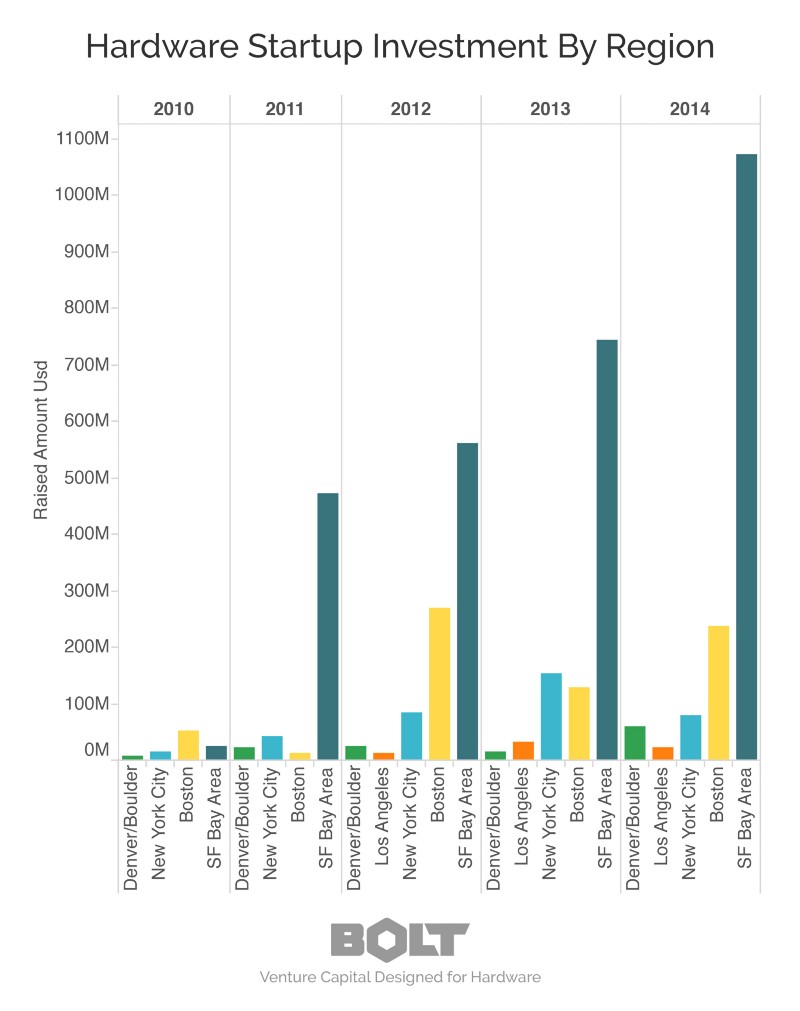
The number of funded, connected hardware startups in the Bay Area (who have publicly raised $1 million or more) currently sits around 110 by my count. Boston and NYC (which are about equal) are one-third of that. Los Angeles and Boulder/Denver are one-third again of Boston and NYC. By aggregate dollars raised, however, San Francisco completely dominates; it was almost 5x Boston in 2014 and more than 10x NYC and Boulder. Everywhere else (including internationally) is a rounding error with a few very notable exceptions (Xiaomi, DJI and Magic Leap, in particular).
Hardware startup investment by region

Why Now?

Three main dynamics have been driving private investors to seek hardware companies.
Strong Exits
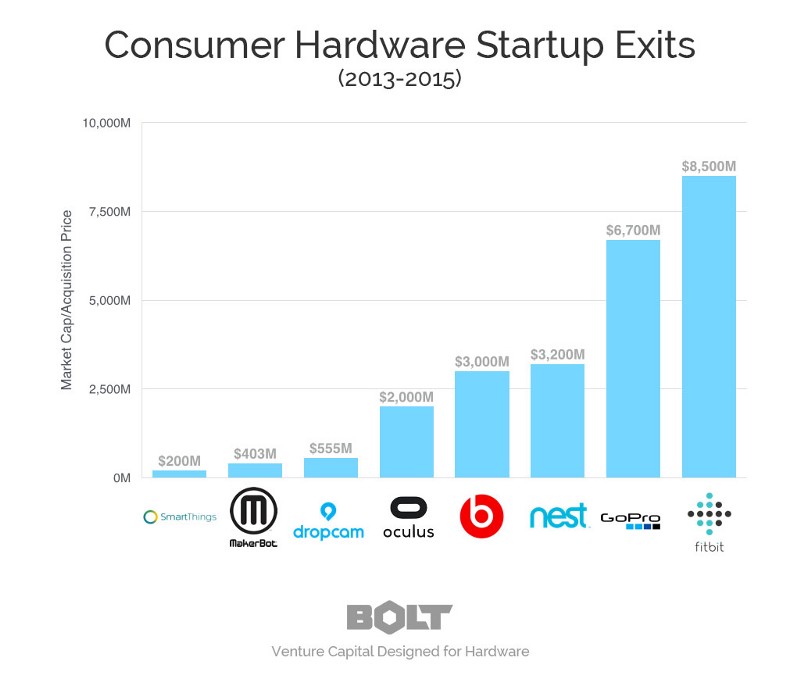
Consumer Hardware Startups

A few breakout companies have paved the way in proving that hardware companies can be tremendously profitable. Distribution and manufacturing are still hard, but GoPro and Fitbit have shown that hardware can have stronger growth metrics and outcomes than their software-only counterparts.
SaaS-Like Metrics
While traditional hardware companies have few feedback loops besides revenue and returns, connected hardware startups get constant feedback on product usage, retention and churn. This speeds up iteration cycles and helps investors (who are already comfortable with SaaS) understand younger hardware companies without as much sales traction.
Hardware + Software = Less Commoditization
Most hardware products struggle with commoditization and low margins over time. Today’s connected hardware products are often a Trojan horse for software. Software that is harder to replicate can increase switching costs and provide more opportunities to interact with customers and build brand. The upshot is a higher customer lifetime value, either explicitly through recurring revenue (Dropcam) or consumables (Kindle).
While the past few years have been banner years for venture capital investment, the connected hardware ecosystem has seen particularly explosive growth in both the number of startups and the receptiveness of VCs to funding them. This is driven by decreased development costs, shorter times to market and a shift in hardware business models away from commoditized consumer electronics to recurring revenue and software services. 
This year is on track to surpass 2014 in both number of funding rounds and aggregateinvestment, although growth is leveling off as a number of hardware categories become saturated and the ecosystem figures out who the winners are. As the hardware community evolves, there are a number of sectors where we’d love to see more hardware startupsworking.